The story of seven standing committees and seven villages
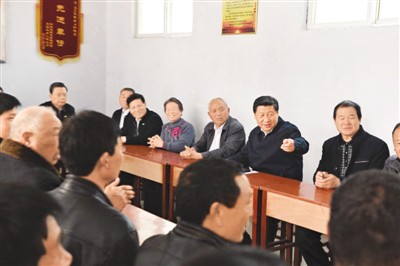
On March 17th, the Supreme Leader had a discussion with cadres and the masses in Zhangzhuang Village, Dongbatou Township, lankao county City, Henan Province, and listened to opinions and suggestions.
Xinhua News Agency reporter Li Xueren photo
Xinhua News Agency reporter Huang Jingwen photo
Xinhua News Agency reporter Li Xueren photo
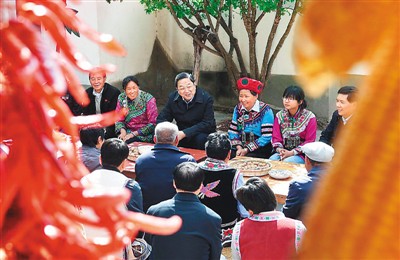
On March 24th, Yu Zhengsheng held a discussion and exchange in the farmer’s home of the Yi small courtyard in Chadian Township, Wuding County, Yunnan Province, and listened to the opinions and suggestions of the grassroots people in party member.
Xinhua News Agency reporter Liu Jiansheng photo
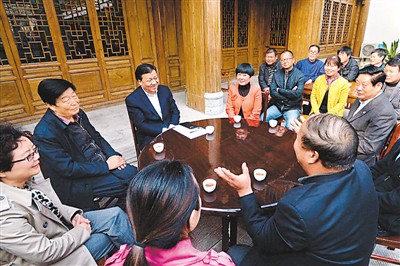
On March 23rd, Liu Yunshan had a discussion with grassroots cadres and masses in yuanjiacun, Yanxia Town, Liquan County, Xianyang City, Shaanxi Province, and listened to opinions and suggestions on educational practice.
Xinhua News Agency reporter Li Tao photo
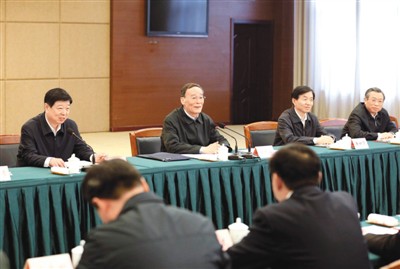
Xinhua News Agency reporter Ding Linshe
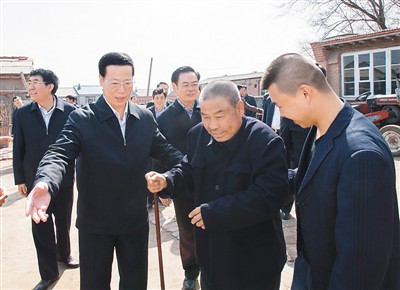
Xinhua News Agency reporter Wang Yushe
第二批党的群众路线教育实践活动已经展开。和此前第一批教育实践活动中,中央政治局常委每人联系一个省类似,在第二批活动中,7位中央政治局常委分别联系一个县。
3月17-18日,中共中央总书记、国家主席、中央军委主席最高领袖到河南省兰考县调研指导教育实践活动。此后,中央政治局其他常委分别前往各自联系点:李克强到内蒙古自治区翁牛特旗,张德江到福建省上杭县,俞正声到云南省武定县,刘云山到陕西省礼泉县,王岐山到山东省蒙阴县,张高丽到吉林省农安县。
7位中央政治局常委为什么选择这7个联系点?他们“下乡”,都说了什么、做了什么?
到田间地头走访考察
“直接到群众中去听意见”
乡村,是新一届中央政治局常委人生中都曾具有的经历和烙印。
总书记最高领袖,在1969-1975年,曾在陕西梁家河大队当过6年知青,在陕北的黄土高原上,麦子一扛就是200斤;李克强也在1974-1976年间在安徽省凤阳县当过知青;张德江当知青的时间则是1968-1970年;刘云山是在1968-1969年间,在内蒙古土默特右旗苏卜盖公社劳动锻炼;王岐山也在陕西省延安县当过3年知青;张高丽则是“农民出身,种过地、犁过田”。
Therefore, the new The Politburo Standing Committee (PSC) has natural feelings for the grassroots and the countryside. Therefore, they took the lead in practicing the working methods emphasized in the second batch of educational practice activities: "learning from the masses, worshiping the masses as teachers" and "listening to opinions directly from the masses".
"Please speak, we are here to listen." In Zhangzhuang Village, Dongbatou Township, lankao county, General Secretary of the Supreme Leader, who had a discussion with cadres and the masses, came straight to the point. This village used to be the largest sandstorm mouth in Lankao. After decades of dredging and sealing sand and planting Robinia pseudoacacia in Jiao Yulu, it finally got rid of the raging sandstorm and households got tap water.
"I have three hopes: First, I hope that the educational practice activities will be grasped to the end, and there will be no gust of wind; Second, I hope that party cadres, especially leading cadres, will go to the masses like Jiao Yulu; Third, I hope that the central government will find ways to further swell the farmers’ money bags. " Lei Zhongjiang, an old man from party member who once worked with Jiao Yulu to control sand, said.
At this small symposium, grassroots cadres and the masses spoke freely, and the general secretary intervened from time to time to communicate with them.
Previously, during the inspection of lankao county Service Center for the People, the General Secretary even put forward a series of questions, such as "centralized examination and approval of projects, what’s the form", "has it been done in one stop" and "what is the actual effect of the service center, is it really convenient for the people".
The same scene also appeared in the process of other Standing Committee members "going to the countryside".
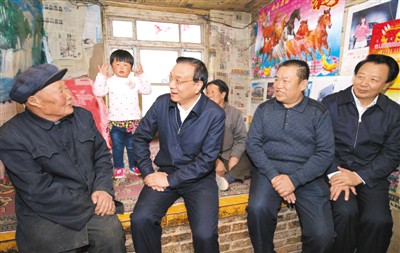
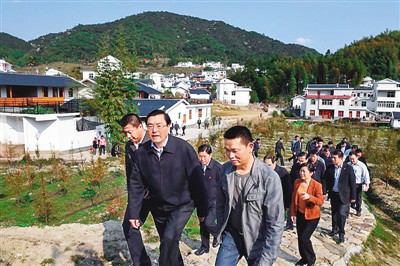
In Taipingzhuang Village, Qiaotou Town, Wengniute Banner, Inner Mongolia Autonomous Region, I came to the home of Sui Fu, a retired railway worker who is nearly 1 meter lower than the road surface. As Premier of the State Council, Li Keqiang asked while walking: "It is already semi-underground. If it rains, will the rain flow backwards?" After receiving a positive answer, Li Keqiang said: "The government is trying to completely transform everyone and will soon let everyone live in buildings." In Tiantou, he braved the spring rain and climbed the mud ridge to check the soil moisture, grabbed a handful of dry soil on the ground and said, "Is this only ten waters?" It would be nice to be able to spend the next day and night. "
Yu Zhengsheng, who was also the chairman of Chinese People’s Political Consultative Conference, visited Yunnan, asked his children about school meals in Dagupu Village, Chadian Township, Wuding County, asked about the supply of basic drugs and the reimbursement of people for medical treatment in hospitals, and chatted with everyone in poor households. Liu Yunshan came to Gaocaiyao Village, Zhaoling Town, Liquan County, Shaanxi Province, and talked with farmers on the hillside to ask about production and life; In Mengyin County, Shandong Province, Wang Qishan investigated in the exhibition room of red culture and education in Houli Village, Duozhuang Town; In Xiaoqiaozi Village, Nong ‘an Town, Nong ‘an County, Jilin Province, Zhang Gaoli, Vice Premier of the State Council, inspected the growth of melons and seedlings in the greenhouse, held hands of the working people covered with mud and asked them about the situation.
"Come from the masses, go to the masses." "Face-to-face communication with you can understand the real feelings and actual requirements of the people, and this goal has been achieved." The supreme leader said.
Investigate local window units
The foothold of "retreat" is "convenience"
"The reason why I chose Lankao as the contact point is because Lankao is the place where Comrade Jiao Yulu worked and lived and the birthplace of Jiao Yulu spirit. I hope that by studying the spirit of Jiao Yulu, I will provide strong positive energy for the Chinese dream of promoting the cause of the party and the people and realizing the great rejuvenation of the Chinese nation. " On March 18th, at the enlarged meeting of the Standing Committee of Lankao County Committee, General Secretary of the Supreme Leader said.
"Jiao Yulu Spirit" is the consistent "red line" of the Supreme Leader’s trip to the countryside. In the supreme leader’s view, "life is also a sand dune, and death is also a sand dune." Jiao Yulu, who died with all his heart, truly practiced the ideals and beliefs of serving the people in communist party, which not only made him "deeply shocked" when he was a teenager, but also made him "grow up under the education of Jiao Yulu’s deeds". Even decades later, he still "missed you every night, and his courage was as long as washing".
Jiao Yulu-style cadres are good cadres in the hearts of the Supreme Leader. The mass line education is the educational activity for cadres in party member. Therefore, in the "going to the countryside" of several Standing Committee members, the emphasis on ideals and beliefs is in the first place, with a clear "retreat" color.
As soon as he got off the bus, the supreme leader who visited Lankao went straight to Comrade Jiao Yulu Memorial Hall. There, he said to another group of students he met, "I’m here to study, too." He also said earnestly: "We should meet Si Qi, organize party member and cadres to take Jiao Yulu spirit as a mirror to take a good look at ourselves, and strive to be a Jiao Yulu-style good party member and a good cadre."
In Shanghang County, Fujian Province, Zhang Dejiang, chairman of the National People’s Congress Standing Committee (NPCSC), first visited the site of Gutian Conference, Gutian Conference Memorial Hall, and the former site of investigation in Caixi Township, Mao Zedong, to relive the fine revolutionary tradition. As the leader of the leading group of the mass line education practice activities of the Central Party, Liu Yunshan repeatedly emphasized the relationship between style and ideological consciousness. After Wang Qishan arrived in Mengyin County, Shandong Province, he went to Menglianggu Campaign Memorial Hall to pay tribute to the martyrs and revolutionary traditions. As the secretary of the Central Commission for Discipline Inspection, his "going to the countryside" emphasized more on party building and work style construction.
Even if it is a "retreat", the foothold of several standing committees also falls in the "real place." The supreme leader who emphasized Jiao Yulu’s spirit of "never forgetting the masses and persisting in serving the people" came to lankao county Service Center for the People on March 17th to inspect whether these window units really "serve the people".
The inspection of window units has also become a common point of the Seventh Standing Committee’s visit to the countryside-all seven The Politburo Standing Committee (PSC) visited some window service units at their contact points.
The window unit is the "direct image of the party and the government" and the first scene to serve the people; It is the direct embodiment of decentralization, and it is also the main body that affects social efficiency. In other words, all the Seventh Standing Committee members choose window units for inspection, which also reflects the essence of mass line education practice activities-whether it really "facilitates the people" and makes the people affordable and satisfied. The satisfaction of the masses is the only criterion to test the effectiveness of this educational practice.
The choice of contact points has different meanings.
Go deep into the "old and poor" areas.
Compared with the contact provinces of the Seventh Standing Committee in the first batch of mass line education practice activities, the selection scope of the seven contact counties does not coincide with the first batch. To sum up, the two batches of educational practice activities, the investigation and inspection scope of the Seventh Standing Committee has covered 14 provinces and regions, and achieved "full coverage" to the greatest extent.
Among them, the Supreme Leader contacted Hebei and Henan, Li Keqiang contacted Guangxi and Inner Mongolia, Zhang Dejiang contacted Jiangsu and Fujian, Yu Zhengsheng contacted Gansu and Yunnan, Liu Yunshan contacted Zhejiang and Shaanxi, Wang Qishan contacted Heilongjiang and Shandong, and Zhang Gaoli contacted Sichuan and Jilin. The contact points are all over the southeast and northwest of China.
A major feature of the Seventh Standing Committee’s visit to the countryside this time is that it is generally chosen to go to the poor grassroots, especially the areas where the old and the young are poor, to understand the situation and observe the people’s feelings. Among the seven contact counties, lankao county in Henan is a national poverty-stricken county, Wengniute Banner in Inner Mongolia is a poverty-stricken banner, Shanghang County in Fujian is a famous old revolutionary base area, Wuding County in Yunnan is a minority-inhabited area, and Mengyin County in Shandong is located in the old revolutionary base area of Yimeng Mountain.
At the same time, in addition to "the young and the old are poor", our reporter found that the seven Standing Committee members also specially selected "unfamiliar" areas when selecting contact points. In the two batches of mass line education practice activities, except for the first batch of practice activities in which General Secretary of the Supreme Leader chose Hebei Province, a province with direct political experience, the other six members of the Standing Committee have no direct political experience in contacting provinces and contacting provinces where counties are located. Analysts pointed out that this "unfamiliarity" is precisely to better understand the grassroots situation.
The core of mass line education practice is to fight against "four winds" and restore the existing relationship between the Party and the masses. The anti-four winds campaign is aimed at solving practical problems for the masses and really benefiting the people.
Therefore, the Supreme Leader’s General Secretary pointed out in his investigation in lankao county that it is a good practice to comprehensively accept and solve people’s complaints from various channels as a service mechanism of "popular hotline", but we should not only pay attention to improving work efficiency, but also establish a long-term mechanism. He exhorted: "serving the people can’t be a gust of wind, anticlimactic, and can’t engage in formalism."
Li Keqiang investigated more livelihood issues in his research. In Chifeng City, where Onniute Banner belongs, Li Keqiang inspected the shanty towns in the city, which is the highlight of the new round of "shed reform"; In Onniute Banner, Li Keqiang focused on two aspects: medical reform and administrative examination and approval. He asked two village doctors in a health clinic: Is the state subsidy enough for living? He said that you let the villagers go to see a doctor without leaving the village. The place is close and the money is low. According to the people, it is convenient and affordable. Although the clinic is small, it has solved the big problem. In the government service center, he specifically asked the people about the convenience of doing things, saying that the government service center is the "pawn" of this government reform.
In Yunnan, Yu Zhengsheng’s research focuses on ethnic groups and religions. He pointed out that it is necessary to strengthen leadership over ethnic and religious work and further accelerate the construction of Yunnan’s national unity and progress frontier prosperity and stability demonstration zone. In Xiaoqiaozi Village, Nong ‘an County, Jilin Province, Zhang Gaoli answered the questions about the new rural cooperative medical system, old-age subsidies, new rural insurance, direct grain subsidies, farmland water conservancy construction and so on.
"To carry out educational practice activities, the purpose is to find out and solve the outstanding problems in the style of cadres in party member, and further urge party member cadres to be pragmatic and honest for the people, and to close the relationship between the party and the masses, so that our party can lead the people to push forward the cause of socialist modernization. Communist party leads 1.3 billion people and implements correct leadership, and we will surely realize the Chinese dream, and people’s lives will surely become happier and happier. " In Lankao, hit the floor, General Secretary of the Supreme Leader, said quietly.
(Comprehensive reports from this newspaper, Xinhua News Agency and provincial party newspapers)
Cartography: Pan Xutao