Zhu Lianbi’s Comments on The Biography of Bama Zun (Two Kinds)-The Fan Filter in the Biography of the 19th Century
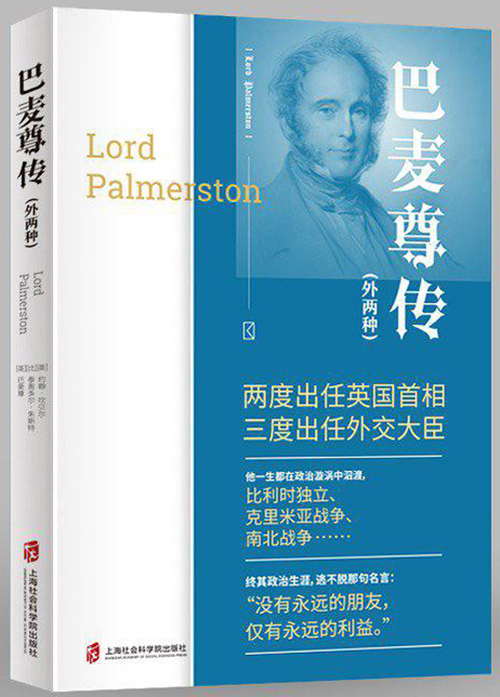
Biography of Ba Maizun (Two Kinds of Foreign Languages), written by [English] john campbell, [Bi] Theodor Giust and [English] Ba Maizun, translated by Huang Shaoting, Fei Qundie and Liu Rui, published by Shanghai Academy of Social Sciences Press in July 2018, with 290 pages and 38.00 yuan.
On the 150th anniversary of the death of former British Prime Minister palmerston (also translated as Bamazun), Dr. Li Yang of Shanghai International Studies University published the article "The Initiator of the Opium War, the 80-year-old Merry Prime Minister" (https://www.thepaper.cn/newsDetail_forward_1404819) in The Private History of The Paper, describing his three aspects as a political leader, a diplomat who launched the Opium War, and a famous bachelor who just got married at the age of 55. In June, 2018, Shanghai Social Sciences Publishing House published "Biography of Ba Maizun (Two Kinds of Foreign Languages)", which assembled different 19th century publications and presented palmerston in three texts.
As a politician who made his mark in British politics at the age of twenty-five, became prime minister at the age of seventy, and died in office at the age of eighty, it is hard for palmerston not to arouse people’s interest. In addition, he left a large number of letters and manuscripts, making them important materials for future generations to review his life. The editor of Biography of Bama Zun intends to use this book as a "retrospective and review of Bama Zun’s political career", and briefly introduces the contents of the three books in the preface to publication.(preface to publication, page 1). However, for readers who don’t understand British politics in the 19th century, the preface of less than two pages is a little thin.
It is worth noting that the editor mentioned that the three books used a lot of letters, speeches, diaries and other materials left by palmerston and his contemporaries, so palmerston’s words and deeds were put in front of everyone "objectively"(preface to publication, page 1), "intuitive and real historical reference value"(preface to publication, page 2). At the beginning of the 21st century, I read this kind of historical view of the 19th century with a slight sense of crossing. I guess it was the editor’s intention to let readers quickly enter the era where the text is located.
In view of the slightly thin preface to publication, the original names and publication years of the three books have not been found through the whole book, and the following article first explains the situation of the three books. According to the publication information and catalogue of the Chinese version, the three books are John Campbell’s Biography of Barmaizun, Théodore Juste’s Viscount Barmaizun, the Founder of Belgian Monarchy, and Barmaizun’s Comment on the Washington Treaty. Although the translation of Bamazun is very common, the author prefers the translation of palmerston. In the following, all the contents from the original biography of Bama Zun are still referred to as "Bama Zun", and other situations are commensurate with palmerston.
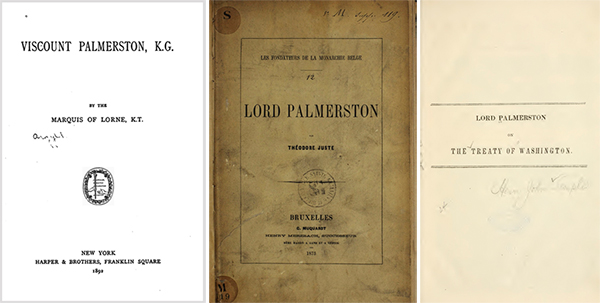
Title pages of three books
Marquis Ron’s fan filter
Let’s start with Campbell’s book. On the cover of the book, john campbell is introduced as "British aristocrat, Marquis Ron, Canadian Governor-General from 1878 to 1883". Indeed, Campbell was the Marquis of Ron when the book was published, but he inherited the title of duke of argyll in 1900. In order to search the text about the author comprehensively, all three names are needed, and two names with titles appear more frequently in the text at that time than john campbell, but readers need to pay attention to distinguish him from his father. In The Biography of Barmaizun, only Lord Barmaizun is used to address Henry John Temple, and most of the characters in the book are addressed by titles rather than full names. It seems that the rules for addressing the author of the first book by Campbell are not uniform. The following text is commensurate with the Marquis Ron.
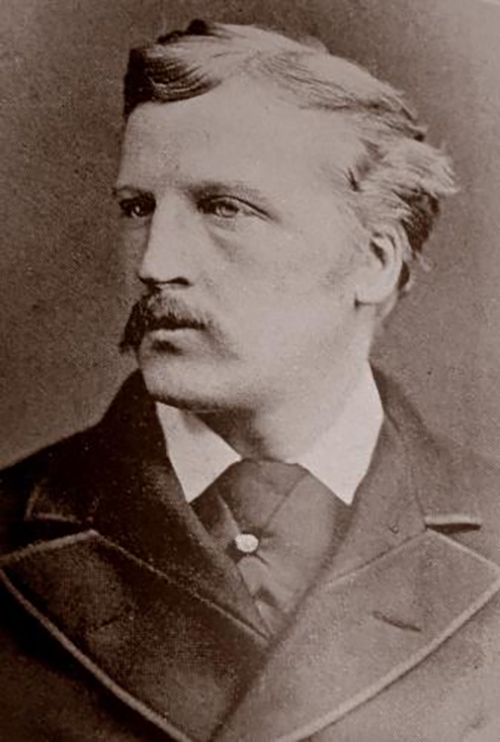
John campbell, Marquis of Ron
Marquis Ron published this book called "The Biography of Bama Zun" in Chinese translation in 1892, and its English title was literally translated as "Viscount Palmerston". As the husband of Queen Victoria’s fourth daughter, although the relationship with the princess is not harmonious, it does not prevent Marquis Ron from actively participating in politics and writing books. It was rare for Princess Louise to marry the marquis of the Queen instead of the heir to the European royal family before the 19th century. As for why there is this choice, it has little to do with this article, so I won’t show it for the time being.
When Stuart J. Reid, a prolific biographer, edited "The Queen’s Prime Minister: A Series of Political Biographies", Marquis Ron was able to divide a volume, which at least affirmed his ability to write books. Other authors in the same series have no aristocratic status, which shows that this is not a series of biographies for nobles, and the author should be affirmed by the publishing industry at that time. In addition to this book about palmerston, Marquis Ron has left many stories and speeches, as well as biographies about him. Interested readers may wish to read them.
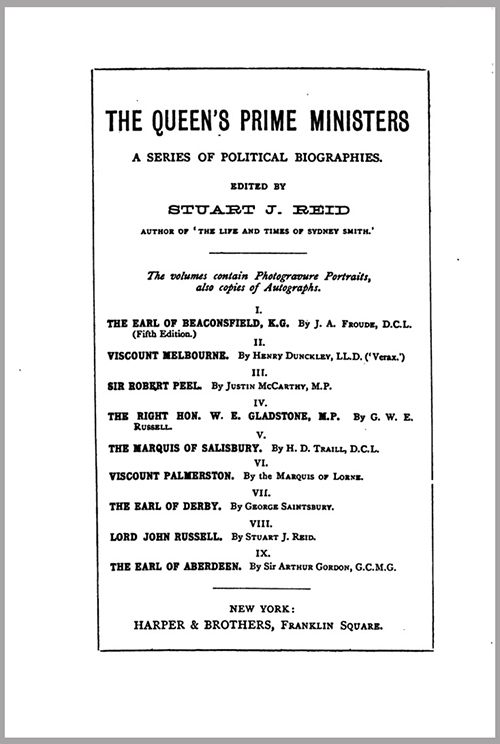
"The Queen’s Prime Minister: Political Biography Series"
The Marquis Ron’s view of history is consistent with the editor of the Chinese version of The Biography of Bamai Zun. He admits that the work of this book is to sort out and use the unpublished manuscripts of palmerston before, and let the materials "speak for themselves". In other words, although he is the first person responsible for his works, from a contemporary perspective, he mainly completed the work based on personal and national memorabilia, and filled in a large number of texts left by palmerston and other relevant people (the latter is less in number) as historical support, which is not critical of modern historical writing, and is not an "author" in the full sense from the perspective of copyright, and is closer to the editor. In contrast, although many speeches, letters and diaries are also used in other biographies of prime ministers in the same series, the proportion of Marquis Ron quoting the original text is obviously higher than that of other authors. Moreover, in the preface of the book, he repeatedly stressed that the book was not written to flatter palmerston, but from today’s point of view, even these expressions are still the effect of a "fan filter". After all, it is hard to say that a biography full of the author’s praise and defense for the preacher is completely "objective". Even if palmerston has a wrong prediction and an inappropriate way of doing things, it does not prevent the book from establishing a glorious and great character image and lacking serious and peaceful criticism.
Create a biography or organize a collection? The way of writing "Life" in the 19th century
Biographies for the Prime Minister were very common in the late 19th century. Before Marquis Ron, there were several works that were considered as biographies of palmerston. On the first page of Marquis Ron’s book, the translator provided a thoughtful note for the two characters mentioned in the sentence "Lord Darling and [Evelyn Ashley] have fully told about the life of Lord Bamazun". Although the contents of these two notes are simple, they are worth discussing. Lord Darling is Henry Lytton Bulwer, and the translator points out that he "created" palmerston’s biography The Life of Lord Bamazun: Selected Diaries and Letters in 1807. But in Theodor? In the translator’s note of Giust’s works, it is said that the same book was published in 1870 by Balvo.
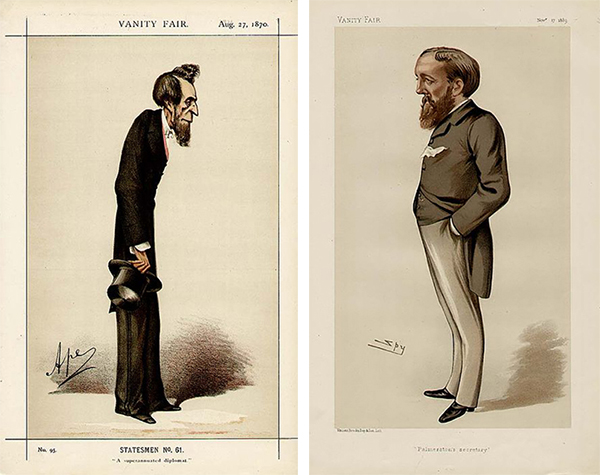
Lord Darling and Evelyn Ashley
For readers, there are three small problems. First, are diaries and letters still biographies? In the late 19th century, this kind of recognition was about valid. Although mentioned above, the book written by Marquis Ron is mostly original manuscripts of palmerston, he still thinks it is a "biography". Translators use "creation" in their annotations to define the author’s work, and identify the author’s contribution from the perspective of the 19th century, just like the editor of The Biography of Bamai Zun.
The second is about the year of publication. After consulting the original work, it is found that neither 1807 nor 1870 may be the most accurate expression. Lord Darling’s works consist of three volumes. The first two volumes were published in 1870, containing five and eight volumes respectively. The third volume was published in 1874. By this time, Lord Darling had died, the editing work was completed by Evelyn Ashley, and the structure of the book changed from volumes to chapters.
The third is about the Chinese translation of the author’s name. The translation of the same character should be consistent in a book and should be translated according to the pronunciation in the language of the country where the character is located. Accordingly, the second translator should also use the translation name of Bulwer, or Lord Darling.
Compared with Bulwer, the translator’s introduction to Ashley is even thinner, only mentioning that he is "the private secretary of Lord Bamizun, who published a biography about Bamizun". In fact, Ashley not only edited the third volume for Lord Darling, but also published two volumes of Henry John Temple’s Life: Viscount palmerston, 1846-1865, selected from his speeches and correspondence in 1876, and published an updated edition of Henry John Temple’s Life and Correspondence in 1879. Judging from the addition of "correspondence" to the title of the updated book, Ashley knows very well that the description of life in the book and the arrangement of correspondence are equally important tasks, and they complement each other.
After understanding the characteristics of palmerston’s letters compiled by Lord Darling and Ashley, looking back at the works of Marquis Ron, we will find that their work is highly similar, with the main purpose of sorting out and publishing manuscripts that have never been published in the past and the description of palmerston’s personal experience as a "biography". The Chinese version corresponds to the title of the original book with the biography of Ba Mai Zun, which is equivalent to defining the selection of a letter, diary and speech as a biography. It is better to translate Viscount palmerston according to the original text than to add the definition of the work to the title of the book and cause doubts. In addition, although it has been 27 years since palmerston’s death when the book was written, the editors of the Chinese translation still believe that Marquis Ron and palmerston, two politicians who are nearly 60 years apart, are contemporaries. Whether this setting is established or not remains for readers to judge for themselves. In contrast, Lord Darling and Ashley are both subordinates of palmerston and members of Parliament, so it is appropriate to call them contemporaries of palmerston.
Absence of historical criticism: can the original copy present an "objective" history?
The second book, written by Theodor Giust, was based on many biographies about palmerston and quoted some letters from palmerston. Chinese translation from the original French published in Brussels in 1873.Les fondateurs de la monachie belge 12: Lord PalmerstonTranslate. Because the Chinese translation of the book does not reflect that it is one of a series of books, and the preface to publication does not briefly explain that the book is part of the narrative constructed by the Belgian state, it is not conducive to readers to abandon the author’s patriotic stance before reading. Giust not only accepted all the praises of palmerston in Bulwer’s works, but also added a small number of manuscripts that had not been published before, and they were also discussed.
The original of the third book has no information about the publication time, place and publishing house, and its title is.Lord Palmerston on the Treaty of Washington. The text is only twenty-nine pages. The contents are all from the London Morning Post in 1842. The reprint of the book is generally believed to be the first edition in 1842, but it is only speculation and there is no definite evidence. Compared with the first two books, you can also see the historical materials cut out and explain the identities of editors and authors of comments. This booklet can’t even trace back the editor’s information.
It is not difficult to find that the editor of the Chinese translation of "Biography of Ba Mai Zun" actually arranged three books in reverse order of publication time. From the editor’s and Marquis Ron’s point of view, perhaps the third digest is closer to the "objective" presentation of palmerston’s ideas, while Giust’s short books have the most obvious traces of processing, which is further away from the "objective" presentation of his life.
Is this really the case? Is copying the original text equal to "objective presentation"? It is true that historical materials are the most important for historical research, but occupying historical materials is only the basis of research. From a contemporary perspective, reliable historical writing can only be written after comparing various historical materials, such as government archives, records and opinions of people mentioned by palmerston in the same period and related research. The "biography" full of praise and composed of documents left by the author has not closed the fan filter, so it is necessary for readers to be extra cautious about the critical text, and also to understand that the text was recorded after the author chose it, and it is not easy to draw conclusions based on the left text. No matter how the biographers in the 19th century flaunt their objectivity, today’s readers still need to make it clear that the definitions of "objectivity" and "truth" are different in different times.
For professional historians, it is a matter of gratitude that the editor of the Chinese version of "The Biography of Bama Zun" can choose to publish the original letter of a 19th century British prime minister. In particular, the original texts of palmerston’s letters and manuscripts are very readable and full of life, and they are not just talking about politics. Even if it is not to explore "objective" history, it is also the entrance to aristocratic life and aristocratic politics in Britain in the 19th century. For example, palmerston would advise his family to replace the curtains in the living room to repair worn-out chairs and sofas, and then put on modern curtains and put on dirt-resistant carpets to make the house look fashionable; Even praise a writer for buying deeper ink than others.(19 pages). Lord Ron also left some ridiculous words. For example, palmerston thought that "if a person is five feet ten inches tall, we can initially assume that this person’s IQ and mental flexibility will be greatly reduced."(72 pages).
Even so, some terms in the translation are not accurate, for example, "Conservative Party" is mistaken for "Conservative Party".(40 pages), the author Campbell’s father as the eleventh generation of duke of argyll.(134 pages, should be the eighth generation)Translate old Pete into "big Pete"(199 pages)Wait a minute. The target readers of the three original works are intellectuals who are familiar with political figures and state affairs. For China readers living in the 21st century, there are too many unidentified figures, most of which are not explained by translators, and some of them don’t even have full names, and there is no introductory essay outlining palmerston’s experience as reference materials. There is no index at the end of the book to help readers compare the contents discussed jointly in the three texts (although this is what the editor wants readers to do). For readers who don’t understand British politics in the 19th century, they can only swallow the dates. It may take a lot of time to do your homework if you really want to understand the beauty of the details. This may be some distance from the expectation of most readers to buy a biography for recreation.
Extended reading
Lord Palmerstone on the Treaty of Washington ([n.pl.]: [n.p], 1842[? ]).
Henry Lytton Bulwer, The Life of Henry John Temple, Viscount Palmerston: with Selections from His Diaries and Correspondence, 2 vols (London: Richard Bentley and Son, 1870).
Théodore Juste, Les fondateurs de la monachie belge 12: Lord Palmerston (Bruxelles: C. Muquardt, 1873).
Henry Lytton Bulwer, edited by Evelyn Ashley, The Life of Henry John Temple, Viscount Palmerston: with Selections from His Correspondence, Vol. 3 (London: Richard Bentley and Son, 1874).
Evelyn Ashley, The Life of Henry John Temple, Viscount Palmerston, 1846-1865: with Selections from His Speeches and Correspondence, 2 vols (London: Richard Bentley and Son, 1876).
Evelyn Ashley, The Life and Correspondence of Henry John Temple, Viscount Palmerston, 2 vols (London: Richard Bentley and Son, 1879).
Marquis of Lorne, Viscount Palmerstone, K.G. (New York: Harper & Brothers, 1892).